

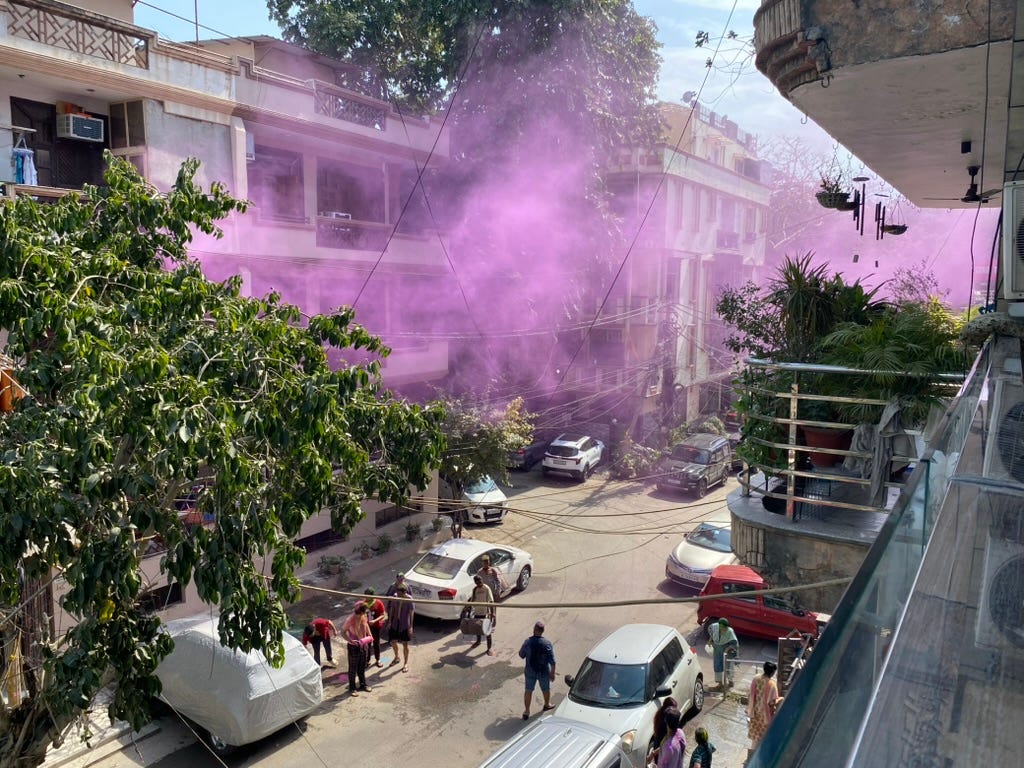
Holi: Festival of Color, 2025
Please read the earlier version in this series: India Diaries #1: Identity in Motion.
Memories That Made Me
Returning to a home that you have longed for is not the same as being a tourist. You don’t just have images but experiences to rely on. What you see may change, how you feel may alter, but in the long run, how do you experience the same place?
The silence of small-town Botswana was unnerving for someone from Delhi. The quiet of small-town America, despite its beauty, gets one accustomed to an existence away from deliberate interference. Meaning, you can sit in your apartment for a whole week without anyone knocking at your door. (Let’s not count the telephone calls from telemarketers). In India however, upon my return after years, I wondered,
‘How do people think here? There is so much ‘sound.’
Never a quiet moment on the streets of Delhi.
And then there came a sound, that made me understand it all.
I remember one episode from my first year back. I was sitting in the living room when I heard a soul-stirring flute. I dropped what I was doing and ran out with my camera. ‘Where are you running to?’ asked my confused mother and sister.
‘The bansuriwala—the flute man.
‘Yeah, so?’
They did not realize that it was not common for me. I didn’t realize how much I missed India until I heard it.
Just having someone pass through your street, playing an ordinary flute, could awaken something sweet in your heart—like a long-lost sound of the universe.
In suburban America, the streets are often remarkably quiet. Except perhaps for children playing during the summer. Too many people lingering for too long on the streets in residential areas can spell trouble. It’s normal to hear an occasional vehicle passing by — but only occasionally, since everyone has a parking space and even cars have allotted spots. In the cities, people avoid living in the busy areas, both for safety and sanity. But to hear someone playing music as he passes through your street?
Impossible!
Sounds of flutes, hand-held drums, devotional singing, and metallic or colorful plastic whistles right in your lane are common in India. Alongside them you hear barking dogs[1], the occasional moo of a cow[2], and birdsong[3].
Although I must share that all the summers that I spent in India before leaving, I woke up to the chirping of birds –mainly sparrows and mynas and fragrance of a special variation of Jasmine called Mongra[4].
My favorite mornings were those when I spotted a parrot on the guava tree in our yard –as we slept near or under it. Parrots love guavas, the fruit that when ripe is green on the outside and pink, red on the inside. We hoped they would drop their green feathers for our collection.

Toy sellers still walk through neighborhoods selling their goods, just as fruit and vegetable sellers bring produce to your door and usually call out their regular customers. Each known for his or her voice and rates.
“Okra! Sweet Mangoes! Come, get yours.” People run out when they recognize the ones they have bought from for years if not generations. “Bananas 100 rupees a dozen.”
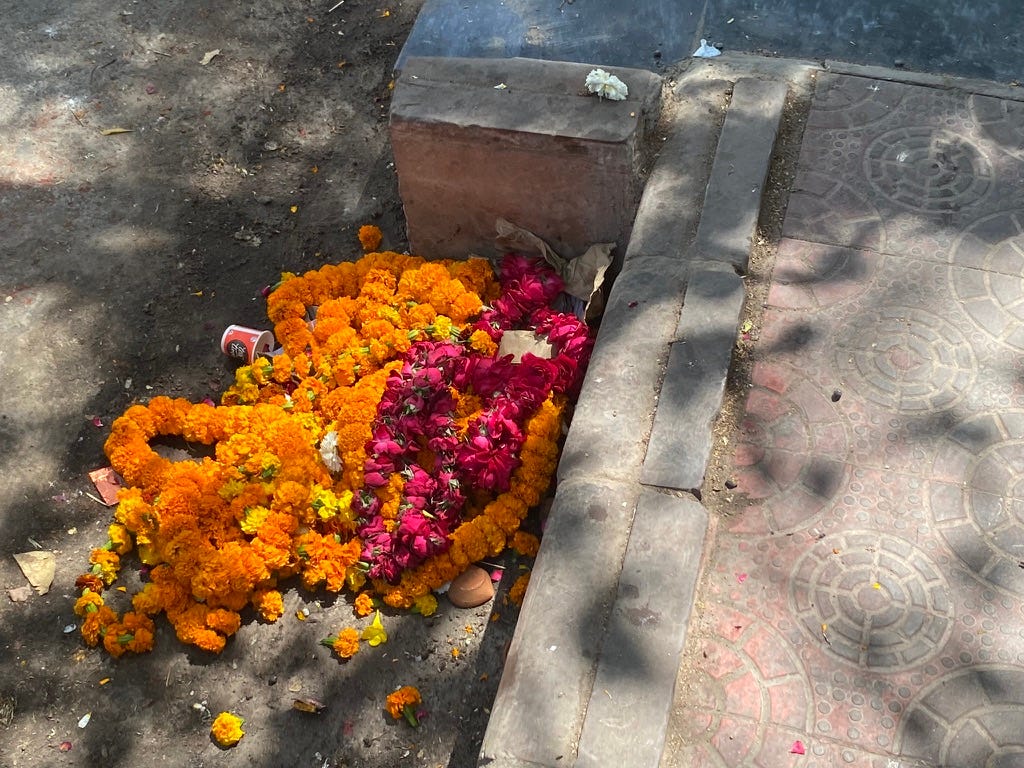
Even the garbage around temples is fragrant.
And you know you can haggle - tell them bananas are too brown or broken. There is a little chit-chat, little laughter, and they are off to next customer, next lane, and you go back to your house. Some vegetable sellers ask me lovingly, “When did you come?” They have known me from when we were all children.
It’s a reminder that there is life, that there is a long-running civilization.
Some things have changed — for example, instead of a pushcart they may now have a motor-driven one — but so much remains the same.

Vegetable Sellers deliver to your doorstep
Think birds, cows, dogs, whistles, drums all mixed with honking and racing wheels.
Then imagine going about your daily chores while someone plays the flute in the background. You hear the sound rise as he nears your house, and then you hear it fade as he walks away.
It may be followed by a racing motorcycle or barking dogs.
But you also get to hear the flute.
Here, watch this video, taken over a decade ago. The neighborhood has changed a bit since then. When I was growing up, the buildings that now look like solid concrete blocks—were houses draped in greenery that spilled onto the streets.
Like a golden thread woven through a piece of rough, uneven embroidery, its sound stands out amidst the surrounding noise. These unique sounds and sights are symbols of civilizational continuity that modernity and globalization have so efficiently erased in many countries.
We grew up listening to stories of Lord Krishna’s flute and how it mesmerized people. Many millennia later, we still have flute players walking through our streets, reminding us that behind all the chaos is Krishna’s flute, melodious, beckoning and reminding us not to take life too seriously.
And listen to sounds of the universe. Enjoy the dance of life, even when you stumble and miss a step.
Here you can watch opening of an award-winning animated series on Little Krishna.
I felt the same delight and calm, when looking at the dusty streets from the window of a moving bus. I would spot a small temple, illuminated and covered in fresh flowers, its bells ringing louder than the Delhi traffic. It seemed as if every other street had a lighthouse of its own. A flame lit thousands of years ago was still burning in the hearts of people for the love of their Gods.
That experience of noticing life and connecting with my childhood started a journey that I have maintained for the last two decades. To visit India at least once a year.
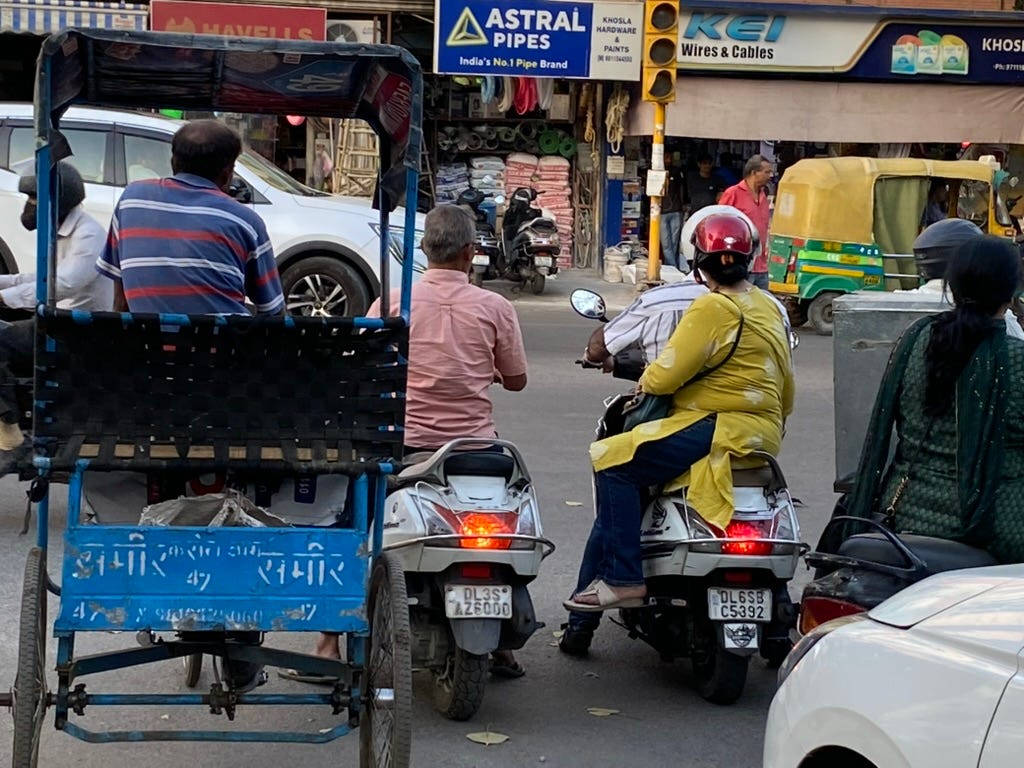
Regular street in Delhi. Can you hear the traffic?
That decision has kept India alive in me and my contacts fresh, renewing and growing.
The first few years were hard. The long stay in the U.S. had weakened my immune system and I’d get sick every visit. Eating street food was forbidden, but I ate it anyway.
A cough that I brought back from India with me, would last six months even after I returned to Pennsylvania.
Yet the illness wasn’t what lingered.
After the cough disappeared, I realized I had carried something else home to Pennsylvania with me. Something so subtle, yet so persistent, that no medicine could cure it.
To be continued.
[1] Which the currently the government is in the process of removing.
[2] Which are rare now since much of the land around houses in Delhi is cemented.
[3] Also rare around neighborhoods these days, but still common open spaces like parks and temples. You will often see left over food, seeds and water placed in public parks.
[4] Mogra (or Mongra) is a richly fragrant variety of jasmine (Jasminum sambac), known for its thicker petals, stronger scent, and close association with Indian summers, gardens, garlands, hair ornaments, and religious offerings.
what a tragedy that all that fullness of life is erased by concrete - like it is in UK towns too - and then they wonder why people are disconnected from their lives - one of the reasons i love africa so much is the animals are everywhere = but not in the cities of course - not any more at least ,