

“I am Kāla (Time),” began the narrator in the opening sequence of Mahabharat, one of the two great epics of the Indian sacred tradition.

Photo by Paurav Shah on Unsplash
Unlike purely solar calendars or purely lunar calendars, the Panchāṅga is lunisolar. It observes both the Sun and the Moon and continuously realigns them so that festivals remain connected with seasons, agricultural rhythms stay synchronized and time itself remains in tune with nature.
The televised series ran for nearly two years and awakened an entire generation to its own stories and civilisational memory. Time itself spoke to the audience in a deep voice — not as a distant observer, but as the eternal witness to human history.
“The Mahabharata is not merely a story from India,” the narrator declared. “It is the story of the rise and fall of a civilisation. It is the story of conflict between truth and falsehood, light and darkness, justice and greed. I alone can tell you this story, because I have lived through it all. I know every character. In fact, I am all the characters — the righteous and the corrupt, the brave and the cowardly. I am also the battlefield.”
The narrator reminds the audience that every age must fight these battles anew, because truth in every era must confront the untruths of its own time. And as long as Time itself continues, the conflict will continue.

Photo by Nathan Dumlao on Unsplash Most calendars tell us what day it is. The Panchāṅga tells us what season we are in, what phase nature is moving through and how life itself is unfolding. (Ajay Chaturvedi
Kāla — Time itself — reminded the viewers that the Mahabharata is not confined to the past. It is a recurring human condition. Time is endless, and therefore the story endlessly returns — sometimes through teachers, sometimes through students, sometimes through kings, and sometimes through ordinary people.
But we all live within Time, moving through its endless cycles like fleeting wisps carried by the wind. To understand and honour these rhythms, we create traditions and festivals, marking time and weaving memories into it.
______
This is guest post number #6 by Prof. Ajay Chaturvedi, a visionary scholar and author whose work bridges Indic knowledge systems, sustainability and civilisational understandings of time. I first met Ajay during the COVID years after responding to a query he had posted on a mailing list. During our conversation, I discovered that both of us had spent considerable time in Pennsylvania. After graduating from IIT, Ajay went on to study at the Wharton School of the University of Pennsylvania.
Over the following weeks, we spoke several times about his book The Lost Wisdom of the Swastika. I strongly felt that the book deserved to be adapted into a film — or perhaps even a television series. Soon afterward, I began developing a treatment proposal based on the book. Although the project still remains in the pipeline, Ajay has since gone on to publish an entire trilogy. His recent books explore the understanding of time within Sanātana Dharma, also known as Hinduism. Two of the three books in the trilogy — The Trilogy of Time and Secret Code of Time — are already available in multiple formats, while the final volume is expected in the coming year.
Ajay’s work on temporal studies — the civilisational understanding of time — is particularly significant in an age where time is increasingly treated only as productivity, measurement and speed. His research explores how older Indic systems understood time in relation to ecology, consciousness, seasons, agriculture and social harmony.
Beyond his academic work, Ajay has studied at Harvard University and the Lee Kuan Yew School of Public Policy, served as Adjunct Faculty at IIT Mandi and IIM Rohtak, and was recognised by the World Economic Forum as a Young Global Leader. He is also the founder of HarVa, widely recognized as the world’s first all-women rural BPO initiative, and is currently developing a Vedic Village in Uttarakhand — envisioned as a living laboratory for sustainability, education and community-centered economic models.
The article itself is short, but quite dense in information.
I recommend reading all the footnotes to understand the Sanskrit words and context.
This post is an insight into Ajay’s decades long research and possibly a peek into what makes Hindu civilization stand out from the rest.
Possibly an understanding that time is the ultimate keeper and narrator of stories.
Here is the link to Ajay’s author page on Amazon.
___________
Understanding the Panchāṅga and the Significance of the Two Jyeṣṭha1 Māsas
By Ajay Chaturvedi
(Trilogy of Time, Secret Code of Time & Lost Wisdom of The Swastika)
How the Hindu Calendar Aligns Human Life with Cosmic Rhythm
Most calendars tell us what day it is. The Panchāṅga2 tells us what season we are in, what phase nature is moving through and how life itself is unfolding.
The modern world follows a calendar built largely for administration — days, months, quarters and years. The Vedic3 tradition approached time differently. Time was not merely counted; it was observed, understood and lived. It was tied to the movement of the Sun, Moon, planets, seasons, agriculture and life itself.
More importantly, our understanding of nature — and our relationship with it — is ultimately defined by how we understand Time. If Time is viewed mechanically, nature becomes a resource. If Time is understood as rhythm, nature becomes something we live in harmony with.
In effect, the way we observe Time defines our relationship with the cosmos and in turn our understanding of our creator, or God as some refer to it.
Hindus worship Bhagawāna4 through the five tattvas5 — Bhūmi, Gagan, Vāyu, Agni and Nīra — not to be confused with elements in modern science. In order to remain in tune with these tattvas6[4], the Hindu tradition follows the Panchāṅga.
The Panchāṅga, the Vedic calendrical system, is among the oldest continuously practiced calendrical systems in the world and remains perhaps the most sophisticated when it comes to tracking seasons, environmental rhythms and staying aligned with nature.
The word Panchāṅga literally means “five limbs” —
Tithi (lunar day),
Vāra (weekday),
Nakṣatra (lunar constellation),
Yoga and Karaṇa.
Together they form a living system of timekeeping based on the movement of celestial bodies.
In effect, the way we observe Time defines our relationship with the cosmos and in turn our understanding of our creator, or God as some refer to it.
When Calendars Follow the Cosmos Instead of the Clock
Unlike purely solar calendars or purely lunar calendars, the Panchāṅga is lunisolar. It observes both the Sun and the Moon and continuously realigns them so that festivals remain connected with seasons, agricultural rhythms stay synchronized and time itself remains in tune with nature.
This is where one of its most elegant features appears — Adhika Māsa7 . This year, that precision becomes visible to all of us.
Adhika or Mal Māsa is often translated as an “extra month”. While technically correct, that explanation misses its brilliance. Adhika Māsa is not an arbitrary addition but a precision correction mechanism built into the calendar itself.
A lunar year is approximately 354 days, while the solar year is around 365 days. This creates a difference of roughly eleven days every year. If this difference were ignored, the calendar would slowly drift away from the seasons. Summer months would gradually shift, seasonal festivals would lose their connection with nature and agricultural rhythms would disconnect from the sky.
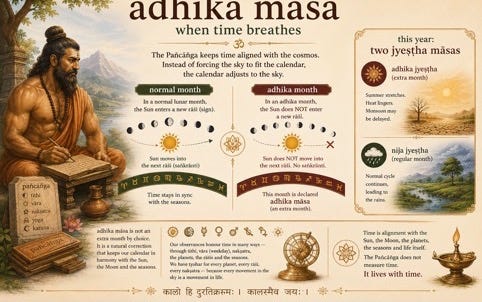
Panchāṅga is both: a universal astronomical system, and a locally rooted ecological system.
The astronomy travels globally; the ecological interpretation arose from observations in India. Therefore the seasonal symbolism is regional rather than universal. Monsoons in India always fall during Jyeshtha Krishna Paksha
The Panchāṅga prevents this drift through Adhika Māsa. Instead of forcing the cosmos to fit a calendar, the calendar adjusts itself to the cosmos and time realigns itself.
The precision lies in how this adjustment occurs.
Traditionally, India follows two methods of reckoning lunar months — Amānta and Pūrṇimānta. In the Amānta system, the month ends with Amāvasyā or the New Moon and the next month begins thereafter. In the Pūrṇimānta system, the month ends with Pūrṇimā or the Full Moon. Both systems are valid and simply begin their counting from different celestial reference points.
Ordinarily, within a lunar month, the Sun enters a new zodiac sign or Rāśi in an event known as Saṅkrānti, which generally occurs around the middle of the month. Makara Saṅkrānti8, for example, marks the entry of the sidereal Sun into Makara Rāśi or Capricorn. Similarly, eleven other Saṅkrāntis occur through the year. These are also associated with the Dvādaśa Ādityas, the twelve solar manifestations among the thirty-three devatās9 of the Vedic tradition.
Occasionally, however, a unique alignment occurs. A complete lunar month passes and yet the Sun does not enter a new rāśi. The Moon completes its cycle while the Sun remains within the same sign. The Panchāṅga recognises this phase difference and designates that month as Adhika Māsa.
There’s no manual insertion and no externally imposed correction. The sky itself determines when balance must be restored. This is one of the reasons the Panchāṅga remains among the most sophisticated calendrical systems in the world. It does not merely count time; it continuously aligns time.

Photo by ASHUTOSH MAHESHWARI on Unsplash
Ordinarily, within a lunar month, the Sun enters a new zodiac sign or Rāśi in an event known as Saṅkrānti, which generally occurs around the middle of the month. Makara Saṅkrānti, for example, marks the entry of the sidereal Sun into Makara Rāśi or Capricorn.
Time as Celebration, Not Calculation:
The Sky as Calendar
This relationship with time is visible even today in our festivals and observances. Across the Hindu tradition, time was never treated as an abstract concept. It was lived, celebrated and observed through the movement of the heavens.
We have observances linked to Tithi, Vāra, Nakṣatra, planetary movements and seasonal transitions.

Photo by Sourabh Barua on Unsplash
Purnima means fullmoon. Buddha Pūrṇimā commemorates the birth of Gautama Buddha. In some traditions, it is also associated with his enlightenment - all believed to have occurred on the Full Moon of the month of Vaiśākha.
Among traditional calendrical systems still in widespread use, the Panchāṅga provides one of the most detailed and astronomically rich descriptions of celestial phenomena throughout the year.
Buddha Pūrṇimā10 is observed on the Full Moon of Vaiśākha. Śani Amāvasyā11occurs when Amāvasyā falls on a Saturday. Guru Puṣya Yoga is formed when Puṣya Nakṣatra aligns with Thursday, while Ravi Puṣya Yoga occurs when it aligns with Sunday. Akṣaya Tritīyā follows Tritīyā Tithi. Gaṇeśa Chaturthī follows Chaturthī. Mahāśivarātri is observed on Kṛṣṇa Pakṣa Chaturdaśī. Nāga Pañcamī, Ratha Saptamī, Guru Pūrṇimā, Kārttika Pūrṇimā, Somavatī Amāvasyā, Budhāṣṭamī and many others continue this tradition12.

Photo by Lukas Robertson on Unsplash
Sani - means Saturday (Saturn’s day). Amavasya means new moon day. Diwali, the Hindu Festival of Lights falls on the darkest Amavasya of the year. Hindus light the streets with lamps to welcome their Lord Rama.
Similarly, the zodiac signs and solar movements also have corresponding observances. Makara Saṅkrānti marks the Sun entering Makara Rāśi, while Meṣa Saṅkrānti, Karka Saṅkrānti and the remaining solar transitions continue through the year. In other words, the Hindu calendar does not merely measure time; it celebrates it.
Time is remembered through festivals, observed through the sky and lived through nature.
Why This Year Holds Two Jyeṣṭha Māsas
This year presents one such fascinating occurrence. We have two Jyeṣṭha Māsas13 — the first being Adhika Jyeṣṭha and the second the regular or Nija Jyeṣṭha.
This is significant because Jyeṣṭha is traditionally associated with summer. Jyeṣṭha is not merely a month on a calendar; it is summer itself.
The word Jyeṣṭha means “the elder”, “the foremost” or “the great one”. It corresponds with the peak of heat, the drying of the land and the waiting period before the arrival of the rains. Rivers begin to recede, the earth heats up and nature enters a period of endurance before renewal.
When an Adhika Jyeṣṭha appears, the summer cycle effectively stretches. The season remains longer within the temporal framework of the Panchāṅga. This is why traditional almanacs often viewed an Adhika Jyeṣṭha as an extension of summer itself, with the possibility of a delayed monsoon and a longer wait before the Earth receives relief.
This is precisely what makes the Panchāṅga remarkable. It is not merely observing celestial movements; it is tracking the rhythm of nature itself. The calendar reads the sky to understand the Earth.
Long before meteorological departments, climate models and satellite systems, environmental rhythms were observed through timekeeping itself. Time was not separated from ecology, agriculture or life. They were all part of the same living system.
The modern world often treats time as productivity — deadlines, schedules and output. The Panchāṅga offers another perspective.
Time is alignment —with the Sun, the Moon, the planets, the seasons and ultimately with life itself.
Adhika Māsa reminds us that time is not merely something we measure; it is something we align with. Sometimes nature stretches a season. Sometimes the sky itself asks for a recalibration.
This year, with two Jyeṣṭha Māsas, summer is taking one extra breath before handing the world over to the rains.
Jyeṣṭha is one of the twelve months in the Hindu calendar, traditionally associated with the peak of summer in India.
The Gregorian calendar is a solar calendar that keeps civil dates aligned with the seasons, while the Islamic calendar is a purely lunar calendar whose months move through the seasons over time.
The Hindu Panchāṅga is unique in that it is a lunisolar system, simultaneously tracking the movements of both the Sun and the Moon and their changing relationship. As a result, Hindu festivals remain tied not only to specific lunar phases and tithis (dates) but also to their traditional seasonal context.
Diwali, for example, continues to fall in the autumn season, whereas festivals in a purely lunar calendar gradually move through the entire solar year. Among traditional calendrical systems still in widespread use, the Panchāṅga provides one of the most detailed and astronomically rich descriptions of celestial phenomena throughout the year.
Beyond determining festival dates, it records a sophisticated range of astronomical information, including transitions and eclipses.
Its calculations are applicable anywhere on Earth, making it one of the world’s most sophisticated traditional calendrical systems and the most precise framework for determining the timing of Hindu festivals and observances. The full moon on May 31, 2026, is called a Blue Moon because the Gregorian month of May contains two full moons. Such a phenomenon does not occur in the Panchāṅga, because its lunar months are defined by the Moon’s own cycle rather than by fixed calendar months. Each lunar month contains a single Pūrṇimā (full moon) and Amāvasyā (new moon), even as the Panchāṅga simultaneously tracks the Sun’s movement to keep festivals aligned with their traditional seasons.
The word “Vedic” comes from the Sanskrit word Veda, meaning knowledge, wisdom, or sacred insight. In the broadest sense, “Vedic” refers to ideas, practices, texts, philosophies, or traditions connected to the Vedas, the oldest foundational scriptures of Indian civilization. In history, “Vedic” refers to the culture, rituals, language, and worldview associated with the period in which the Vedas were composed and transmitted orally in ancient India. There are four primary Vedas.
The Vedic tradition eventually gave rise to:
· philosophy,
· linguistics,
· poetics,
· music,
· cosmology,
· logic,
· meditation traditions,
· and theories of aesthetics like Rasa theory.
Bhagawāna (Bhagavān) is a Sanskrit term used for the Divine or Supreme Being — one who is the source of wisdom, strength, compassion, beauty, and cosmic order. In Indian languages, there are several word for one word God: they all represent various aspects and highlight different qualities. each reflecting different aspects and qualities of the Divine.
Bha-Ga-Va-A-Na (Bhumi-Gaga,-Vayu-Agni-Neer). It’s an acronym
Bha → Bhūmi (भूमि) — Earth. Represents solidity, stability, grounding, form, and material existence
Ga → Gagan (गगन ) — Sky or Ether/Space. Represents openness, vastness, sound, consciousness, and the space in which everything exists.
Va → Vāyu (वायु) — Air Represents movement, breath, life-force, change, and communication.
A →Agni (अग्नि) — Fire. Represents transformation, energy, digestion, passion, light, and purification.
Na → Nīra (नीर) — Water. Represents flow, emotion, adaptability, nourishment, and cohesion.
Tattvas—often translated as the “five elements”—are far deeper than physical matter. The Sanskrit word tattva means “essence,” “fundamental principle” or “that-ness.”
Where else have we heard this idea? Consider the word Hindutva—often reduced today to politics or ideology. Linguistically and philosophically, it may also be understood as referring to the essential nature or “Hindu-ness” of a civilization.
In Indian traditions, tattvas are simultaneously:
• physical
• psychological
• symbolic
• spiritual
• cosmological
The concept of tattva can be found in:
Ayurveda (Hindu Medicine System: The knowledge of Longetivity)
Yoga philosophy and Tantra
temple architecture
dance, music
ritual and even food traditions.
Adhika Māsa literally means “extra month” (adhika = additional, māsa = month). Many Latin and European words share ancient linguistic roots with Sanskrit—for example, māsa (month), Latin mensis and Spanish mes.
Makara Saṅkrānti is considered one of the most significant Saṅkrāntis in the Hindu calendar. Unlike the other monthly solar transitions, it is associated with Uttarāyaṇa—the Sun’s northward journey—symbolizing longer days, renewal, harvest, and spiritual auspiciousness. Across India, it is celebrated through prayers to the Sun, charitable acts, and seasonal rituals reflecting harmony with cosmic rhythms.
A devtā (devatā) refers to a divine being or deity—often understood not simply as a “god” in the Western sense, but as a sacred force or aspect of cosmic intelligence that represents particular qualities of nature, consciousness, or universal order.
Purnima means fullmoon. Buddha Pūrṇimā commemorates the birth of Gautama Buddha. In some traditions, it is also associated with his enlightenment - all believed to have occurred on the Full Moon of the month of Vaiśākha.
Sani - means Saturday (Saturn’s day). Amavasya means new moon day.
Each of celebration mentioned here includes the lunar day of the month in the name. For example, Ganesh Chaturthi-is celebrated on the fourth of that month. Fourth-Chatur (sanskrit)- Quattuor in latin. Ratha Saptamī is a Hindu festival dedicated to the Sun God, observed on the seventh lunar day (Saptamī) of the bright half of Māgha, symbolically associated with the Sun’s movement toward vitality, light and the coming spring.
The Sanskrit word sapta means “seven” and is linguistically connected to Latin septem.
In 2026, the Adhika Māsa is:
Adhika Jyeṣṭha Māsa: approximately 17 May– 15 June 2026. Followed by the regular:
Nija (regular) Jyeṣṭha Māsa approximately 16 June – 14 July 2026