

This post provides context to my article –a memoir-commentary combo published two weeks ago in an online magazine, “It’s the Community, Stupid!”
It’s the Community Stupid! The Lost Art of Celebrating together.
The above article is a reflection on how disruption of communities often follows economic progress and increased use of media—no matter the country. The fragmentation is visible in changes around festivities that were once collective and overlapped all houses in the neighborhood.
These reflections can be applied to countries other than India as well. I have heard similar arguments from the Americans, Swedes, Norwegians and the British. All have had similar experiences.
“Only a few decades ago, when both parents were not working, the women in the neighborhood created an informal but warm community.”
Through ritualized and annual (or recurring) practices that reproduce contact between neighbors---such as trick or treating (Halloween), or a knock at the door from påskkärring (easter witches in Sweden), or a visit from young girls during Navratri1, often received as an encounter with the divine (nine-day celebration of the divine in its feminine form) — people had the opportunity of meeting children in the neighborhood. The playful interaction helped maintain a familiarity and provided an opportunity for creating new memories around the tradition.
Formalities of celebrations are still performed but the warmth from knowing the children in your neighborhood by name, age and hobbies is missing.
I am aware that any conversation about impact of both parents working usually results in “You want women to go back to kitchen?”
The article is not addressing gender wars but highlighting that a loss in collective identity negatively influences the future generation, regardless of the gender. Raising children was not supposed to be a two people job. ‘
‘It does take a village.’
Gabor Mate, stresses that the ‘clan-like’ arrangements for raising children are the best for their emotional and mental development.
“I do not want my child to grow unobserved.” says Ashima, a character in Jhumpa Lahiri’s novel ‘Namesake’, when she tells her husband she wants to return to India, and not raise her child in the United States.
Children in India (as elsewhere too) grew up under the watchful eyes of relatives, neighbors and even market vendors who set up their stall in the same place for years, or the shopkeepers whose family-owned shops have been maintained for over seven decades. Familiarity became a cocoon, a foundation for security.
But what happens when home that was a haven fragments? Where do you return?
In Troubled, Rob Henderson shares that emotional consistency and stable family are more important for children than economic stability. Although the thesis is based on his traumatized childhood as a foster child, and having to move homes, a similar situation of instability is created when adults in the entire neighborhood spend a large portion of the day at work. Working people are usually answerable to those outside the family structure – i.e. jobs can/take priority over emotional relationships. Such a situation is curtailed when children grow up in an extended family network and have several adults to rely on through their developmental years.
I wanted to share the published piece here, but it is easier to understand if readers are familiar with the festival and the memories associated with it.
Another article (linked here) provides deeper context on why young girls are central to the ritual and what that means for the community.
___________
India is the land of festivals. Every two weeks there is a new one. I was reminded of it last year when I spent nearly two months between February and April in Delhi.
There were at least ten celebrations big and small during the two-month period, and the real festive season starts in the second half of the year. That is an advantage of nature-based systems—technically every day is a celebration.
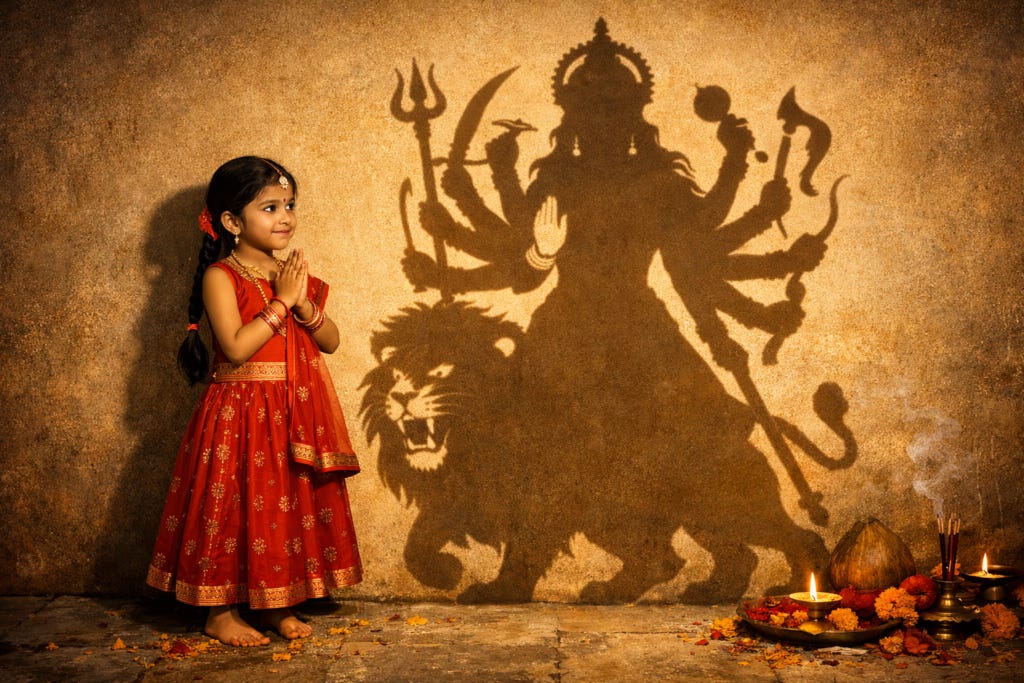
Pre-pubescent girls are honored twice a year, at the change of seasons as a representation of divine energy. You can read more about the significance of this festival by clicking here.
“The age restriction — girls between two and ten, specifically before puberty — is not arbitrary tradition. It comes from a precise Tantric observation about the quality of Shakti in a being who has not yet encountered the hormonal and psychological transformation that puberty brings.
Direct quote from the article. It reflects one interpretation within a broader ritual practice about Navratri traditions.
___
Refugees and Re-Creation of a Community
No theory can completely explain the broken nature of a community forcibly uprooted from its land. The word is diaspora. First applied to the Jewish diaspora, today it commands an entire research area. Regardless of concepts like ‘hybrid identity’ – which implies that diaspora generate a new identity that reflects both home and host country, it is difficult to remain unchanged with movement2.
All migrants try their best to recreate home. Rituals are maintained in connection, not in a vacuum. It is when communities migrate together and settle in proximity that rituals can continue to live. This is why Indian communities in Suriname, Fiji, Guyana, and Trinidad and Tobago were able to preserve Indianness without sustained connection to the motherland.
For reference, most of my observations about India pass through academic, sociological and anthropological lens, but also through a Punjabi lens. India’s diversity is reflected in differences in the way traditions are held across the country.
When food is ordered and not cooked, there is never enough to share it with neighbors. And why would you share it anyway? The whole point of sending food over to the neigbours was to shower love and continue a camaraderie—a knowing.
People ask me, do you speak Indian? Nope, there is no language called Indian. India has twenty-three official languages, many of them with their unique script. You can find about fifteen of them on Indian currency.
The commentary on this blog filters through experience of growing up in a Punjabi neighborhood.
Punjab is one of the three states that was divided during the partition of India in 1947.
Punjab, Gujarat and Bengal.

Photo by Joshua Olsen on Unsplash In ancient civilizational geography described in texts like the Mahabharata, regions such as Gandhāra (in today’s Afghanistan and Pakistan) were part of a broader Bharata-varsha (Alexander 327 BCE). This is very different from the modern political map of South Asia, which was shaped much later through colonial rule, Partition, and the formation of present-day nation-states. In 327 BCE, Alexander entered the northwestern frontier of this world and encountered Gandhāra and other established kingdoms. These were not fragments of a unified empire, but long-standing political and cultural regions within the broader civilizational geography later described as Bharata-varsha (present day India).
What the world today knows as Bangladesh was called East Pakistan, which was a part of Pakistan. Post 1971 civil war, East Pakistan became its own country—Bangladesh-the land of the Bangla people.
Hence, ‘West Bengal’, which is the part remaining after carving out Bangladesh, from the original state of Bengal in India.
Both my grandparents are from Punjab in Pakistan. Neither of them settled in present day Punjab in India. My maternal grandparents are spread over north India in - Delhi, Haryana and Uttar Pradesh. My paternal grandparents moved to Delhi, which is where I grew up. Since we grew up in a neighborhood created especially for refugees from Pakistan, almost all families had similar history, spoke Punjabi, and lived Punjabi traditions. Even in a slightly diluted form, our neighborhood was a continuation of Punjabi culture.

About 15 Indian languages are on Indian currency.
Bowing to Girls
In India, younger people, both boys and girls, greet elders by touching their feet, a gesture of respect. In some communities, including the Punjabi community girls are not allowed to touch either the shoes or the feet elders.
Why? Because Punjabis are Devi worshipers. Devi, the word for feminine form of divine, is seen as reflected in every girl-child. Allowing daughters to touch their feet is akin to asking the Goddess to bow to you. It’s considered a sin. Instead, on certain festivals our parents bowed to us.
A modern man, my father doesn’t care for this ethic, and we were often asked to hand him his shoes. I remember how I loved polishing his work shoes.
“You are incurring a sin!” Ma would wag her finger.
But father has also been our biggest champion, encouraging me to take taekwondo over Indian classical dance. I have travelled this far, because of his support.
Goddesses as Matriarchs
When I understood why daughters were not allowed to touch the feet of their parents, but there was no such restriction in-laws house, other traditions began to make sense too. Ideally, getting married should bring about a psychological change in the couple. They are not children anymore and must learn to be responsible yet remain humble and respectful towards the elders.
At the center of a household is kitchen, which is too sacred to hand over to strangers. Stoves, ovens, skillets and spatulas unite not just family but also neighborhoods.
A post wedding tradition, especially in arranged marriages, is that the bride is given gifts, usually money, for the first meal she cooks at her new house. Usually a sweet dish. Praise is showered on her by her new family (regardless of how it turns out) in the form of gifts. Slowly she’s initiated into the ways of the new family, as she introduces them to what she learnt from her mother. She is gradually introduced into cooking for others, meeting relatives, and learning the rhythms of new relationships that will, over time, support her3.
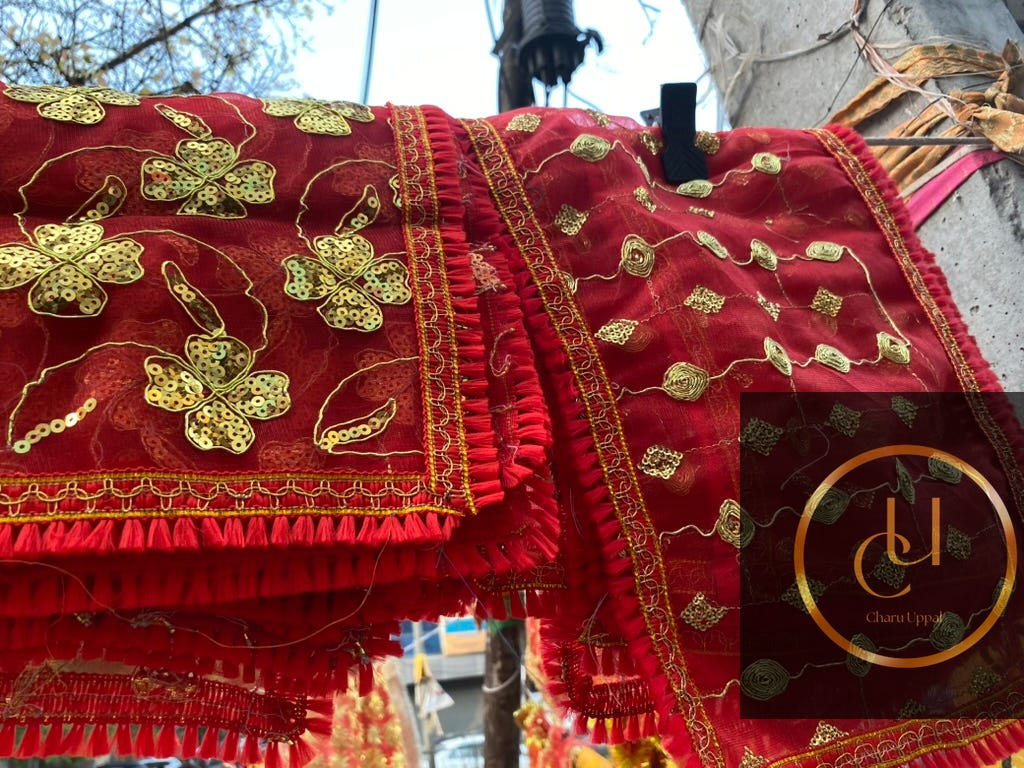
Scarves in red and gold for sale during Navratri. Often these scarves are offered at temples and shrines at home to the Goddess. Photo By Charu Uppal
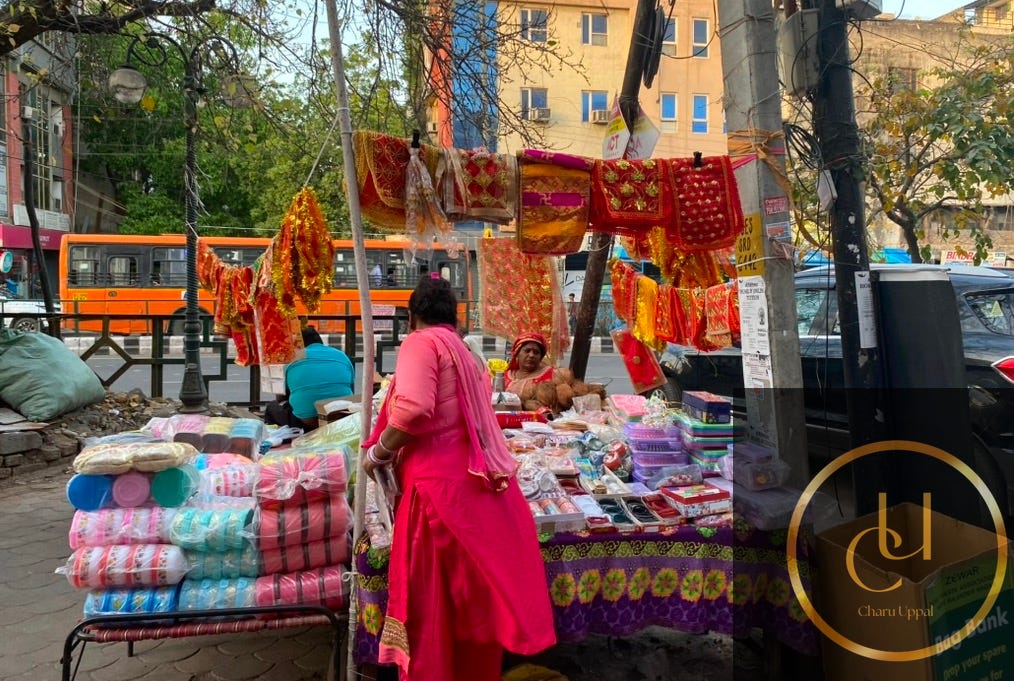
Mother of Change
At the change of seasons comes a nine-day festival when the Devi is invited into homes, and honored through prayer, ritual and servings of food specially prepared for her. On the ninth day, Devi is worshipped in her human form—as a young girl. While this tradition is common to all of India, I know it from having grown up in Punjabi neighborhood, as detailed in the article I shared.
The Goddess is also honored as prakriti—nature. At the start of the nine-day festival women plant wheat in a small container, and harvest it on the same day4, when girls in the neighborhood were invited. When I asked, Ma explained that we were once warriors and landholders. In feudal societies, those who went to war also held land, because land sustained life in the peaceful years between battles. Over time, we became urbanized—no longer living as landowners or warriors or directly connected to the struggles that once defined survival.
Yet, we still owe Mother Earth. We bow to the newly grown wheat- the tender shoots are a reminder of abundance of Bhoomi Devi..5
Indian languages carry the idea that the feminine is not only human, but also sacred. In Hindi, the word maa (mother) also carries the resonance of the divine feminine, Devi. Not used very often these days, Devi, meaning Goddess was the word used to address a woman whose name you did not know—as in Ma’am.
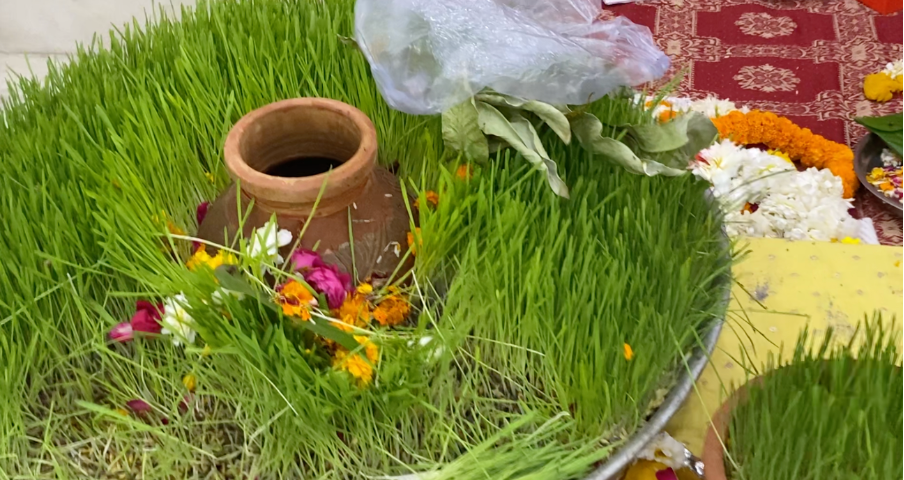
Khetri—wheat germ at the neighborhood temple. Photo by Charu Uppal
There is a saying that the goddess of fortune enters a house two times: first as a daughter, then as a daughter-in-law.
A common saying in India, “Men cannot enter this world save through a woman.”
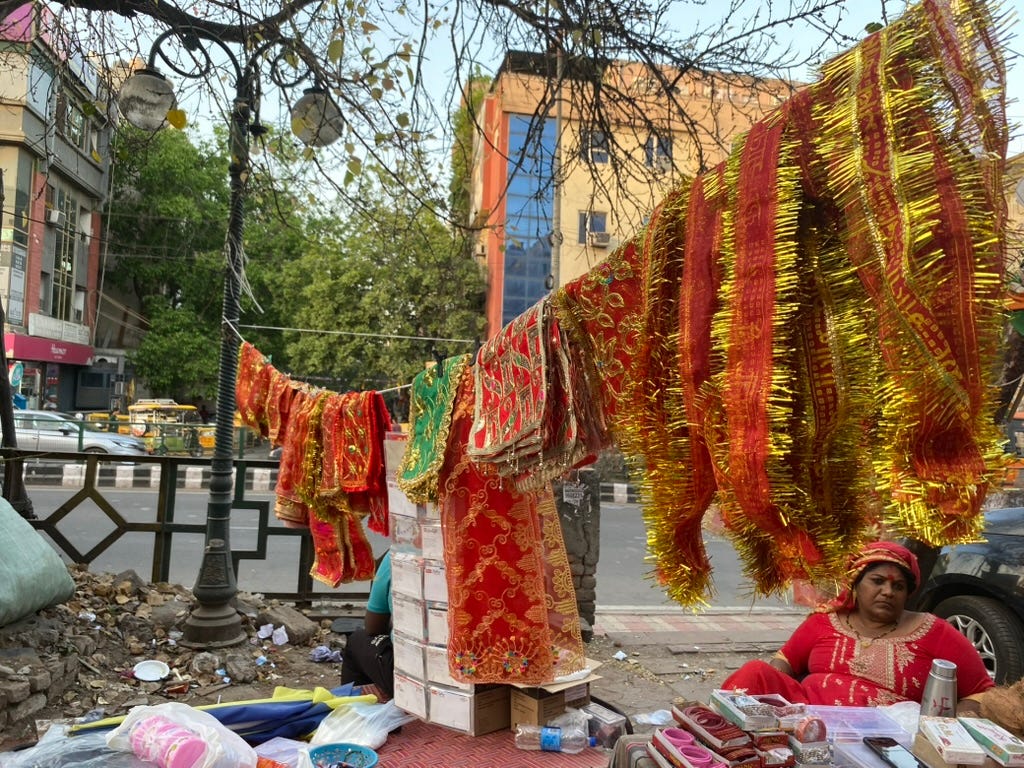
Photo by Charu Uppal
You can read this article HERE to get a better understanding of why young girls are worshipped as Goddesses, and the reasoning behind rituals and foods associated with the festival.
For us girls, Navratri was a fun festival. We had no idea why parents and elders were washing our feet or giving us money.
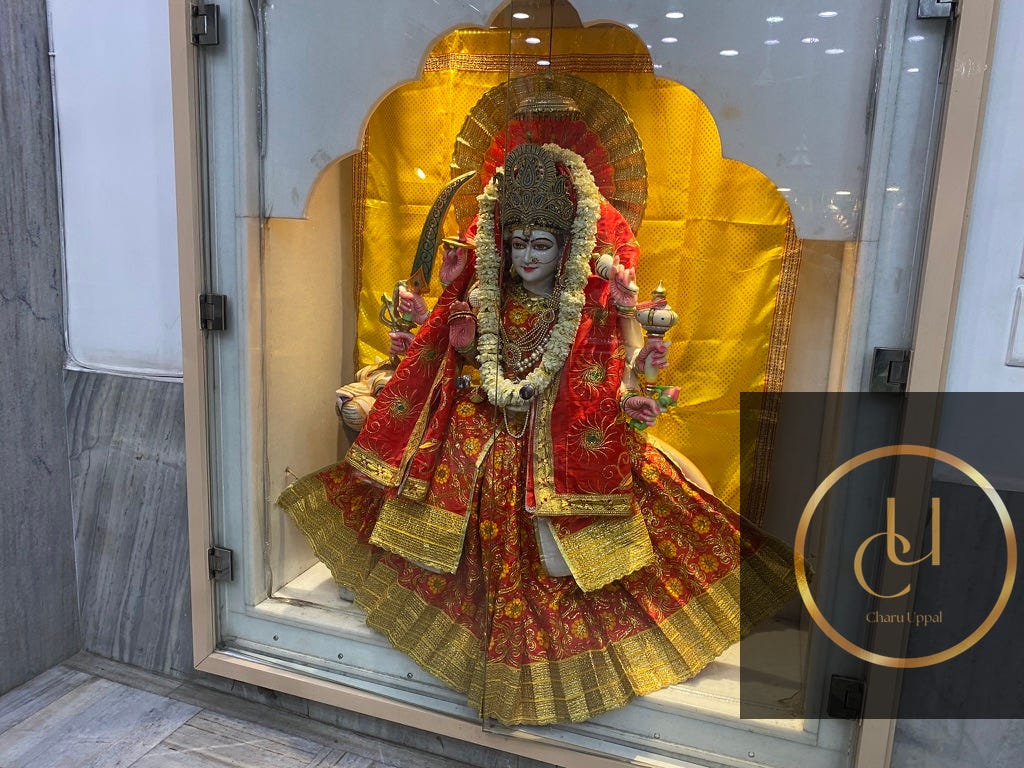
The Goddess all dressed up for the Navratri celebration, in a temple near my parents’ house.
As Culture Dilutes
Movement is not the only reason for a culture’s dilution, but it is the fastest, because change is forced from many directions, including mixed feelings about home. The first casualty is the way one dresses and the way one speaks. The first is required both for climate and cultural reasons, the second is the foundation of survival, because communication rests on it.
For my grandparents the movement was in a way, ‘within their own country.’ Millions of Punjabis arrived in Hindi speaking Delhi and other cities of North India where neither Punjabi culture nor the language was a norm.
That strength in numbers allowed our families to maintain many of their traditions. Our parents and grandparents speak Punjabi, and our wedding rituals are still quite Punjabi. We continue to use Punjabi phrases to discuss life, and our cuisine is a direct descendant of what our ancestors ate, in what is now Pakistan.
Traditions and practices often responded to a need or a wisdom. When we got too convenient with convenience that traditions provided, we forgot the problems that traditions were a response to.
For me, the only hometown is Delhi. Its dialects, and accents, even after being away for decades, still pierce my heart. It was interesting notice how Bollywood mainstreamed Punjabi culture. Until recently many traditions and especially weddings shown in Bollywood were Punjabi, because the film industry despite having its origin in Bollywood was heavily influenced by incoming refugees from pre-partition Punjab.
Much of the food found on menus in Indian restaurants around the world is primarily Punjabi food. Since Punjab experiences extreme winters1, the food has many of the same ingredients such as cream, butter, other dairy products, fried onions, other than the very Indian spices, which gives it a distinct taste.
Believe me, red lentils without cumin, fried onions, ghee6, and roasted garlic, would feel quite bland and closer to what you would find elsewhere in a simpler form.
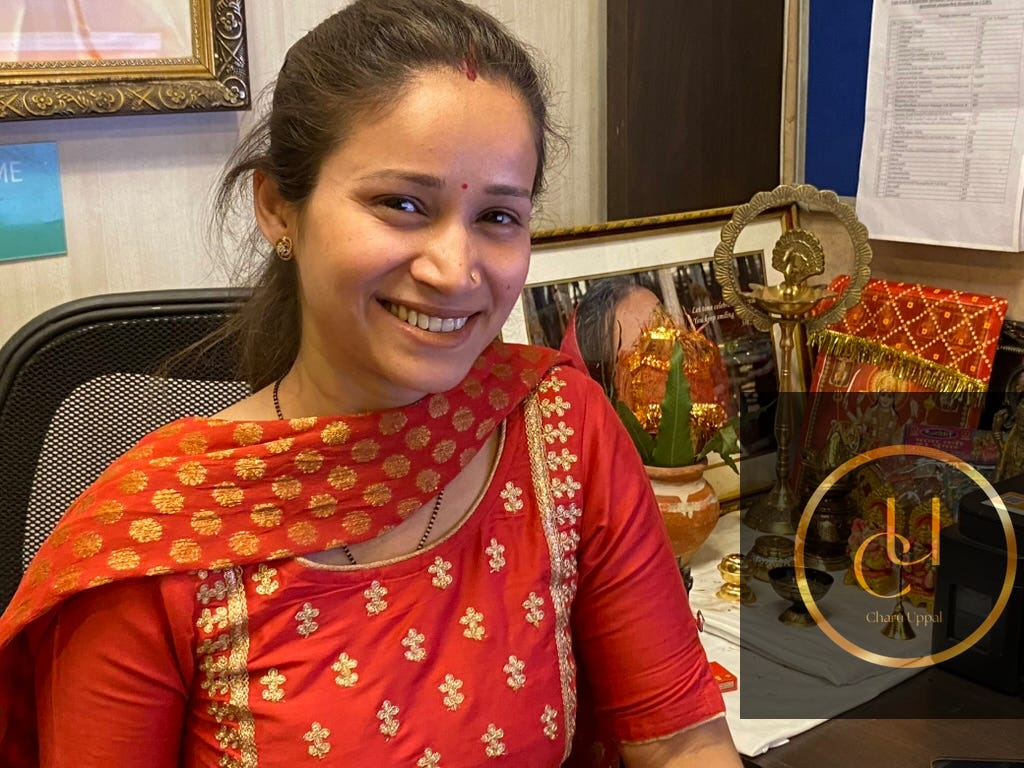
A young woman dressed in the color of the Goddess during Navratri. She works at the Ayurvedic Centre Run by Art of Living Organization. Photo by Charu Uppal
“Jee Aayan nu”: A Welcoming Culture on Decline
One phrase that held deep meaning among Punjabis has almost been lost among Delhiites, “Jee Aayan nu”, meaning Welcome, I give you my entire being.
It was used to address unannounced guests. As an urbanite, I heard it only from my father’s mouth. Unannounced visits that used to be quite frequent are frowned upon now, because the buildings are taller, walls are raised, television is loud and we think forwarding a WhatsApp message is the same as hugging.
Jee Aayan nu was how language supported the spirit and expressed immense love at seeing guests. Another phrase that was used to show surprise that felt like a blessing when guests visited was, “tel choiye aassi?”
“Shall we oil the creaking doors?” Oiling creaking doors was the last task anyone wanted to do, but it was done before special occasions, so the guests feel welcomed in a is well-lived house. An unannounced guest was greeted as a blessing by the hosts, “shall we oil our creaking doors today at this special occasion?”
Remnants of ‘Jee Aayan nu’ are reflected in the numerous parties I have held in every country I have lived. Even today when I visit my neighbors, I take homemade or store-bought food.
During a research visit in New Zealand, I took fruits to Indo-Fijian participants. They smiled and said, “Such an Indian thing to do.” Punjabi wisdom says, “You just don’t arrive empty handed at anyone’s house.’ We were used to taking bags of fresh to relatives every visit.
It’s a form of blessing.
Kitchen the Container of Community
Traditions and practices often responded to a need or a wisdom. When we got too convenient with convenience that traditions provided, we forgot the problems that traditions were a response to.
On the other hand, on with the times, our generation is more at ease with eating pizza and noodles than the previous generation.
“What in the world is this? Give me some pickle, some sauce, some masala….” complained my cousin from Panipat, when we fed him home-made Chinese noodles with a bit of turmeric and cumin.
Despite the Indianization the noodles were still too bland for him. He begged for extra lemon and green chilies.
More women of my generation work outside of the house, and fewer women than in my mother’s generation have time for community or festivities.
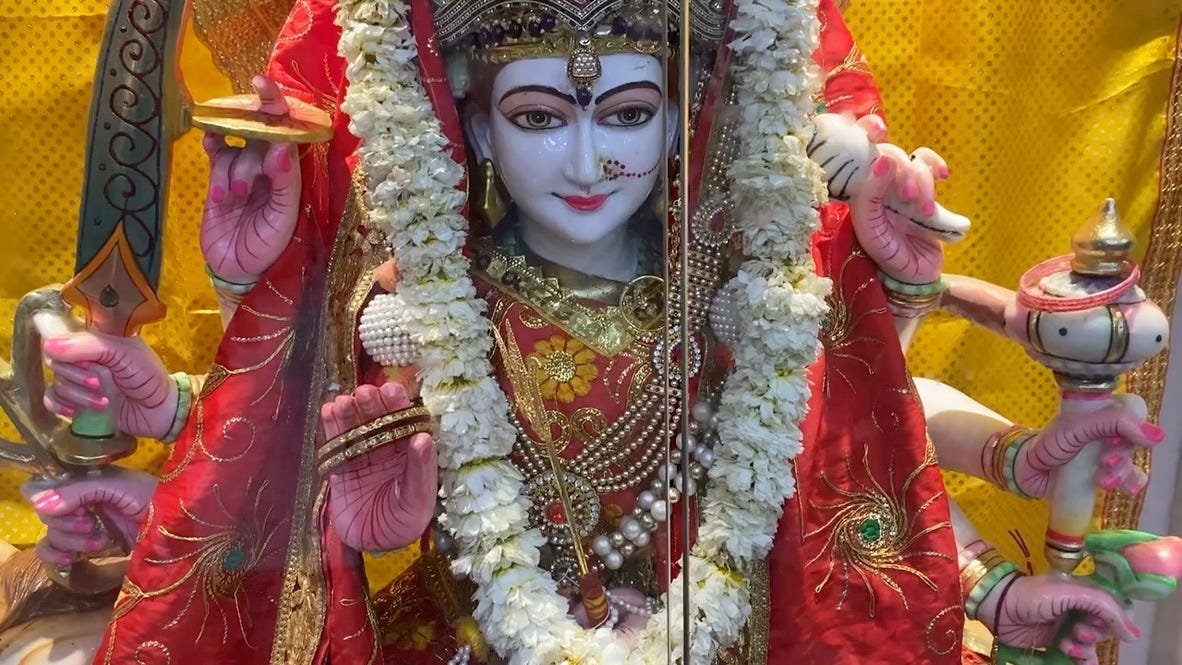
Mother covered in red and gold
The neighborhood I grew up cannot be considered Punjabi anymore, as many families have moved out, and replaced by non-Punjabi families. The biggest difference is crowd on the streets. There are more cars than people. Hardly any children or adults hang out on the street chatting, exchanging food. Older people are confined to their houses watching TV, forwarding WhatsApp messages. Younger ones have long days at work. A new tradition of ‘live-in-Kitchen-help’ has become a norm. An entire generation of women has been raised to be more familiar with ordering food online than cooking, the once forte of Indian women.
But it’s never just about cooking.
When food is ordered and not cooked, there is never enough to share it with neighbors. And why would you share it anyway? The whole point of sending food over to the neigbours was to shower love and continue a camaraderie—a knowing.
“I know you like the way I make chickpeas, I know your son loves my paranthas.”
Who’s to be made responsible for the colossal loss of culinary knowledge? And as a result, dwindling communities that were created around kitchen?
Mediatization Vs. Warmth of Long-Term Communities
Mourning cultural change, which is inevitable with time, is futile. But possibly, if we are conscious of it, then we can at least stall dilution of practices that solidify foundations of cohesion. As a media scholar, I see how media use hastens cultural change.
Mediatization, meaning when our interactions are through the media, changes not only how we communicate, but what counts as presence. Messages replace visits, images replace shared time, and visibility replaces proximity. What once required physical repetition—seeing the same people, in the same spaces, over years—is now outsourced to screens that simulate contact without sustaining it.
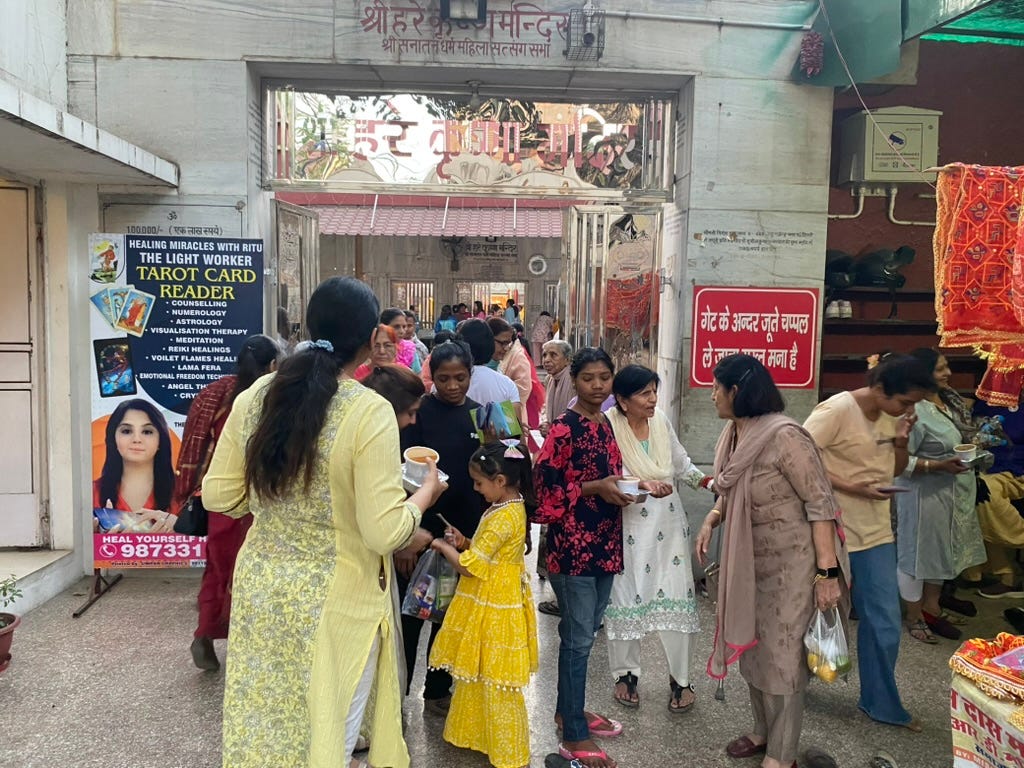
Outside the neighborhood temple. That Tarot Card reader rented the room only two years ago. Before that it was common to find astrologers, but I had never seen one at this temple. Photo by Charu Uppal
Our contact through screens may be continuous but often does not result in frequent physical proximity. In this shift, communities do not disappear suddenly, they slowly lose the small, casual but repetitive interactions which build familiarity.
In one of his books, the award-winning essayist and travel writer Pico Iyer reflects on a California house fire that, for the first time, forced him to speak to his neighbors. Is that what it takes today for us to know our neighbors? What was organic has now become plastic because we think media are a conduit of emotions.
Let me close with an incident from a few years ago.
I had stepped out to the street outside the house to some vegetables from a street vendor who moves his pushcart through the neighborhood three times a day. When I heard my name I looked up.
“When did you arrive?” asked Bhabhi from the balcony, one floor up.
Bhabhi meaning sister-in-law is Kukeraja’s daughter in law. They live one house away. I must have been thirteen or so when she came into the neighborhood. She has an extremely warm presence who always had the time to stop and talk. She’s never worked outside the house, but she’s managed a household and has had the patience and wisdom to maintain a joint family. Since her in-laws passed away, she is the elder in the clan.
We are not related by blood or by marriage but by the street. I hardly ever used her name and just called her ‘sister-in-law,’ so I often forget her actual name.
“Just yesterday, Bhabhi.” Kukerajas are one of the few families that have lived in the neighborhood since my grandfather moved there. Bhabhi’s in-laws behaved like parents to my father, and her husband was like an older brother to us, even though we hardly spoke. My parents attended her wedding, and we were invited to their house for Navratri ritual every year.
“How are you?” Bhabhi asked with the same warmth as she always has.
“The usual….” I said between coughs.
“You’re coughing.” Bhabhi showed concern.
“My visiting gift from Delhi.” I tried to sound funny, even though my throat was dry and painful.
“Come visit.” She knew I won’t have the time or that I am too old to visit without a reason.
A few minutes later, after finishing the purchase, as I was about to go back into the house, I felt a hand on my shoulder. I turned around to see Bhabhi holding a small steel bowl.
“Here, suck on this slowly, or just add it to warm water and take it like a drink. It will easily make you two cups.” I saw that honey in the bowl still had some floating pieces of grated ginger.
“Add lemon according to your liking,” Bhabhi handed me the bowl, “a little extra won’t hurt.”
I let out a sigh as a form of gratitude. In the time it took me to complete my grocery shopping, Bhabhi had squeezed juice out of fresh ginger, added it to honey and had come down one floor.
The bowl in my hand felt warm, my heart was filled and my eyes stung with emotion.
Years of living on the same street, having memories from before I could remember resulted in a home-remedy in my hands, without asking.
That’s what long-standing communities sometimes still manage to do.
Here’s is the article that I wrote where I already notice changes in the community.
Lohri, a Punjabi winter festival where children went door-to-door singing and collecting gur, peanuts, and coins, has largely disappeared in urban Delhi.
Practices that once produced everyday familiarity across households are no longer transmitted in the same way, and what survives often gets reframed as either “folklore” or something belonging to other (often rural or poorer) contexts—quietly turning continuity into distinction, and shared culture into stratified memory.
Indo-Fijians and other similar diasporas created during the British era are different because they were isolated from local Fijian population. Their migration happened before the internet and so if they did not have access to India, they were also not absorbing western-global content. Television did not arrive in Fiji until the 1990s.
I hold my views not in abstraction, but from observing the increasing rootlessness in communities built on minimal obligation to one another. Humans are not self-sufficient beings; most of us would not survive in isolation. We rely on others, and in caring for others we are also sustained. While it is necessary to highlight inequality where care work is unfairly distributed or taken for granted, it is equally reductive to treat care itself—especially within families—as mere oppression. To do so risks stripping everyday acts of devotion of their meaning and replacing them with a form of moral vocabulary that cannot account for love, duty, or continuity. The result is not liberation, but a quieter and more isolated form of life, cut off from the ordinary sweetness of being needed and known. l
Called khetri—meaning a mini farm—. Many urban women have stopped planting wheat after children got married and moved away. Rituals are for people and maintained by people. Homes with dwindling population do not revel in traditions as much. Therefore it was recommended that children and relatives live close by. Opportunity to help and celebrate together is possibly only proximity (and yes, the same proximity allows us to hurt family too.
Bhoomi means ground.
Clarified butter